 La critique matérialiste de l’État.
Une introduction
de Moritz Zeiler

Zeiler, Moritz:
Materialistische Staatskritik
Eine Einführung
1. Auflage 2017, Schmetterling Verlag (lien)
Présentation
Au sein de la gauche anticapitaliste, la question de l’État est synonyme d’un clivage profond. Le spectre d’interprétations s’étend de son idéalisation à sa diabolisation, de sa prise de contrôle à son abolition. Alors que pour certains, l’État est le garant de l’intérêt général, d’autres le considèrent comme un instrument de domination de classe, et d’autres encore le considèrent comme le terrain de luttes sociales.
Dans cette introduction, Moritz Zeiler présente les thèses principales de la théorie marxienne et marxiste de l’État en les articulant sur ce qu’il identifie comme les éléments centraux de la théorie marxienne de la société : Analyse, critique et subversion. Partant des réflexions fragmentaires de Marx et d’Engels sur l’État et la politique, puis présentant la théorie instrumentale de l’État chez Lénine, il expose les théories de l’hégémonie du marxisme occidental de Gramsci, Althusser et Poulantzas, de même que les analyses de Paschunakis sur le lien entre forme-marchandise, forme-droit et forme-État, pour reconstruire le lien qu’elles entretiennent avec les travaux qui s’en inspireront, c’est-à-dire ceux d’Agnoli, Hirsch, Holloway et d’autres encore. Ce livre retrace finalement les débats sur le lien entre l’État et le fascisme, tout en faisant une place aux critiques libertaires de l’État, et aux contributions féministes, sans oublier d’expliciter les enjeux actuels de cette question.
Continuer la lecture →
 Review: Karl Marx and the birth of modern society
 Le dernier Marx
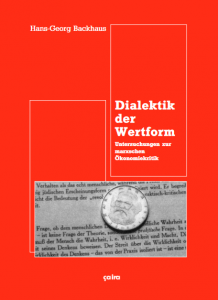 Ouvrage cardinal de la Neue Marx-Lektüre, Dialektik der Wertform de Hans Georg Backhaus.
 La Neue Marx-Lektüre : critique de l’économie et de la société
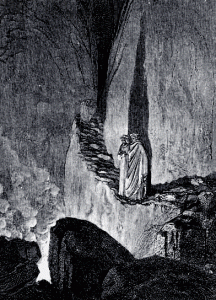 Marx in Hell: The Critique of Political Economy as Katabasis
 Commentaire par Michael Heinrich du début du chapitre 5 du Capital : Procès de travail et procès de valorisation
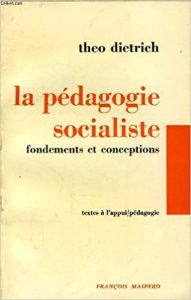 DIETRICH (Théo). — La pédagogie socialiste. Fondements et conception, François Maspero, 1973.
 Robin Small : Karl Marx, The Revolutionary as Educator, Springer, 2014
 Classe, lutte de classe et déterminisme historique Michael Heinrich